Explain This: OpenAI's Tumbler Ridge Apology Is Really a Violence Escalation Policy Story
OpenAI's apology after the Tumbler Ridge attack is really a governance story about when AI providers escalate possible violence signals.
OpenAI's apology to Tumbler Ridge turns a tragic edge case into an operator question.
What should an AI company do when user chats point toward imminent violence, and what proof should exist around that decision?
The easy version of the story is reputational. OpenAI did not alert law enforcement before the attack, then Sam Altman apologized after the fact.
The more useful version is governance. Once a model provider is aware that a user interaction may signal a credible threat, the hard part is no longer just moderation. It is escalation, documentation, and threshold design.
What it is
The immediate news hook is simple. OpenAI's chief executive apologized to the Tumbler Ridge community after the company failed to alert law enforcement about a suspect tied to a mass shooting.
That makes the incident sound like a one-off judgment failure. It is more useful to read it as a systems failure.
A model provider sits on a strange boundary. It is not a therapist, not a police agency, and not just a neutral software vendor. But it may still see user behavior that creates a credible duty to escalate internally, preserve evidence, and make a time-sensitive decision.
That boundary condition is where many AI safety conversations still get fuzzy. Companies talk a lot about harmful outputs. They talk less clearly about harmful signals coming from the user side when the risk looks imminent and real.
Why it matters
This is where privacy, safety, and governance stop being abstract values and start competing with each other in real time.
If the escalation threshold is too low, companies risk overreporting, intrusive monitoring, and weak user trust. If it is too high, the company can end up apologizing after preventable harm while being unable to show who saw what, when they saw it, and why nobody acted.
That is the operator lesson. A post-incident apology is not only a communications problem. It is often evidence that the escalation path was underdefined before the crisis arrived.
For AI companies, the real question is not whether a model can flag troubling language. The real question is whether the company has a defensible process for routing flagged cases to humans, documenting judgment calls, and triggering urgent review when the facts cross a credible-risk threshold.
Where the real policy gap is
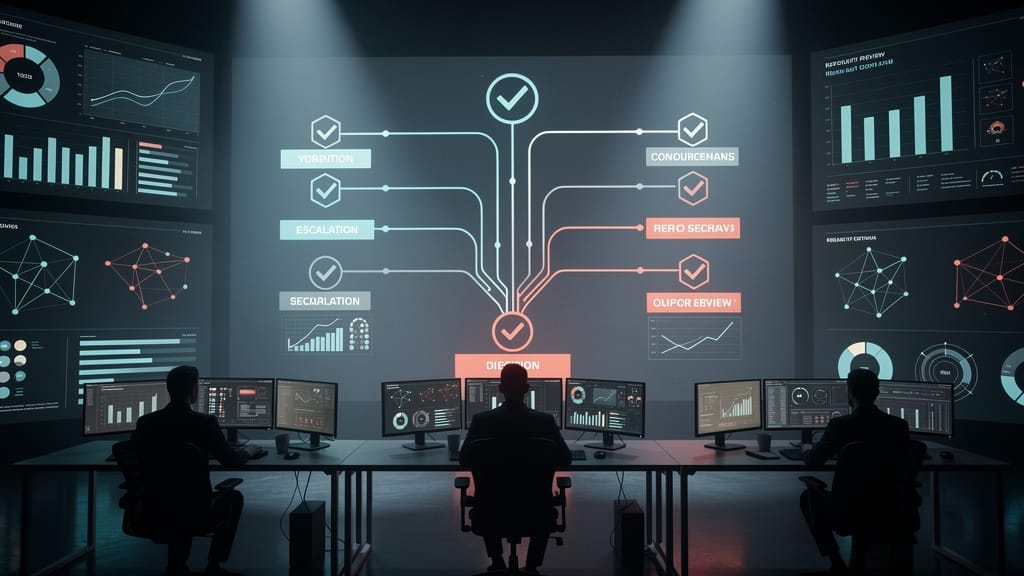
The weakness is usually not the absence of a model signal. It is the absence of decision architecture around the signal.
Who owns the call when the threat is ambiguous but serious?
What is the standard for contacting law enforcement?
What evidence gets retained?
How fast must the review happen?
What gets documented for later audit?
If those answers only emerge after a tragedy, the company does not have a safety policy. It has a hindsight policy.
This matters beyond OpenAI. Any provider offering conversational AI, companion AI, mental health tooling, tutoring, or agentic systems will eventually face the same category of question. The companies that look mature are not the ones that promise they care. They are the ones that can show how an imminent-risk escalation actually moves.
What to do this week
- Define one written threshold for urgent human review when user behavior may indicate imminent violence, self-harm, or other severe real-world risk.
- Separate detection from decision. The system can flag, but a named human owner should decide whether the facts justify escalation.
- Create a short audit trail template with five fields: timestamp, signal observed, reviewer, decision, and rationale.
- Stress test the handoff path with legal, policy, trust and safety, and leadership so everyone knows who is reachable after hours.
- Review whether your privacy promises still hold when emergency escalation becomes necessary, and make the exception language explicit instead of implied.
- Measure time to review for high-risk cases. If the process is too slow for a live incident, the policy is decorative.
The blunt takeaway is that AI safety is now partly an emergency operations problem.
If a company can detect a severe risk signal but cannot turn that signal into a fast, reviewable decision, it has not finished the safety stack.