The Docket: Defensive AI Agents Need a Blast Radius
Defensive AI agents stop being assistants when they can call tools, touch secrets, and change systems without a defined blast radius.
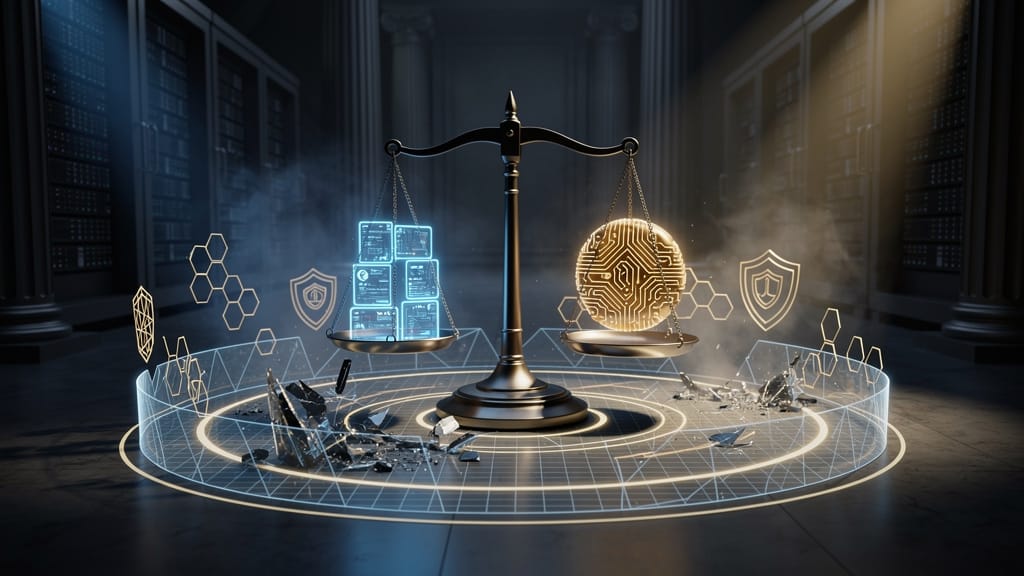
Do not approve AI security agents by vibe. Approve them by blast radius.
That is the practical lesson from AI Now's Friendly Fire work on hijacking defensive cyber AI agents for remote code execution. The point is not that security teams should panic and ban every agentic tool. The point is sharper: once an AI agent can call tools, read repositories, execute commands, or operate inside incident-response workflows, it is no longer just an assistant. It is a privileged automation surface.
What Happened
AI Now published paired Friendly Fire research on defensive cyber AI agents. The exploit brief focuses on how agentic security and coding tools can be turned against the environments they are supposed to defend. The policy brief frames the governance problem that follows when these systems enter high-permission workflows before organizations have matching controls.
The safe reading is important. This is not a claim that every Claude Code, Codex, SOC, or AppSec workflow is automatically compromised. It is a warning that the risk model changes when the assistant gains tools.
A normal chatbot answers. An agent can fetch files, run commands, inspect logs, call scanners, summarize tickets, manipulate repositories, or chain tasks across systems. In a security workflow, that can mean access to secrets, exploit evidence, production-adjacent context, incident notes, customer data, and the exact tools defenders use when the clock is already loud.
That is why defensive use cases are uniquely sensitive. The agent sits inside the trust path. It is invited into the room because the work is urgent, technical, and noisy. If its permissions are loose, its execution environment is shared, or its tool calls are weakly reviewed, the organization has not deployed a helper. It has introduced a new control plane.
The Operator Lesson
The operator lesson is containment, not abstinence.
Security leaders already know how to think about endpoints, IAM, CI/CD runners, privileged access, and logging. AI agents need the same seriousness. If the agent can act, it needs a boundary. If it can touch evidence, it needs a log. If it can change state, it needs an approval gate.
This is where a lot of AI adoption governance loses the thread. Teams ask whether the model is good enough, whether the demo is impressive, or whether the productivity gain is worth the spend. Those are not the first questions for defensive agents. The first questions are operational:
- What can this agent read?
- What can it run?
- Which credentials can it use?
- Which actions require human approval?
- Where are the prompts, tool calls, outputs, and approvals logged?
- How fast can we revoke access and quarantine artifacts if the workflow misbehaves?
If those answers are unclear, the agent is not ready for privileged work.
The legal and compliance side is just as practical. A company that deploys an agent into SOC, AppSec, engineering, or incident-response workflows should expect to produce evidence later. Not marketing evidence. Control evidence. Scope, least privilege, tool allowlists, approval records, log retention, revocation procedure, and proof that sensitive data was minimized instead of casually fed into a broad automation loop.
What to Do This Week
- Create a one-page blast-radius record for every AI agent approved for security, engineering, incident response, support, or production-adjacent work.
- Put agent execution in a sandbox by default. Use disposable containers, isolated workspaces, read-only mirrors, or separate worktrees before letting an agent touch sensitive environments.
- Issue scoped credentials. Do not let agents borrow broad human tokens, shared admin accounts, or secret bundles intended for interactive staff workflows.
- Define tool allowlists. State which tools the agent may call and which actions need human approval, especially network access, package installs, deployment steps, credential access, destructive filesystem actions, and code changes.
- Preserve audit logs. Keep prompts, retrieved context, tool calls, command output, approvals, resulting commits, and configuration changes tied to the agent session.
- Minimize data exposure. Give the agent the evidence pack it needs, not the entire secret-bearing environment because that is easier.
- Build a kill switch. Security teams should know how to revoke tokens, stop sessions, disable tool access, and quarantine generated artifacts quickly.
The useful rule is simple. Treat AI-agent onboarding like endpoint and IAM onboarding, not like installing a browser extension.
A defensive agent can be valuable. It can also become the fastest path between a malicious instruction, an overbroad credential, and a production-adjacent action. The difference is not branding. It is whether the organization defined the boundary before the agent started moving inside it.